On June 11, an extraordinary thing happens in Palm Springs. The gates of Frank Sinatra’s legendary Twin Palms estate — a private residence tucked into the Movie Colony East neighborhood — swing open for a rare summer architectural tour, part of XOXO Palm Springs: a citywide arts and culture festival running June 11–22, 2026.
If you have any interest in Coachella Valley real estate, architecture, or what actually drives value in the mid-century modern market, this is the two hours you should not miss.
This isn’t nostalgia tourism. It’s a masterclass in why architectural provenance translates directly to price premiums, resale strength, and enduring buyer demand — lessons that apply whether you’re shopping at $800,000 or $3 million.
The Story Behind the House
In May 1947, a young man in a white sailor hat walked into a small office on South Palm Canyon Drive eating an ice cream cone. He wanted a house — Georgian, specifically, ready in time for a Christmas party.
The man was Frank Sinatra. The architect was E. Stewart Williams, a 29-year-old who had recently established his practice in Palm Springs. Williams did something brave: he prepared two sets of blueprints. One Georgian, as requested. One modern — flat-roofed, horizontal, floor-to-ceiling glass, designed to belong to the desert rather than contradict it.
Sinatra chose the modern version. That choice set the course for the valley’s architectural identity in ways neither man could have anticipated.
The house Williams designed is 4,500 square feet, sited on just over an acre in Movie Colony East. It features long horizontal roof planes, a canopy skylight entry, four bedrooms, seven bathrooms, and the now-famous piano-shaped swimming pool — which Williams always insisted was an accident of geometry, not a tribute to his client’s instrument. Twin Palms was designated a City of Palm Springs Class 1 Historic Site in 2011 and listed on the National Register of Historic Places in 2016.
[Norman: Insert a specific observation here — what do you notice when you drive past Twin Palms on Alejo Road? What do buyers say when you mention it on a showing?]
What E. Stewart Williams Actually Built
Twin Palms was Williams’s first residential commission, but it launched a career that shaped the physical fabric of the entire valley. He went on to design the Palm Springs Art Museum (then called the Palm Springs Desert Museum), the Coachella Valley Savings & Loan buildings, and dozens of private residences that became benchmarks of the form.
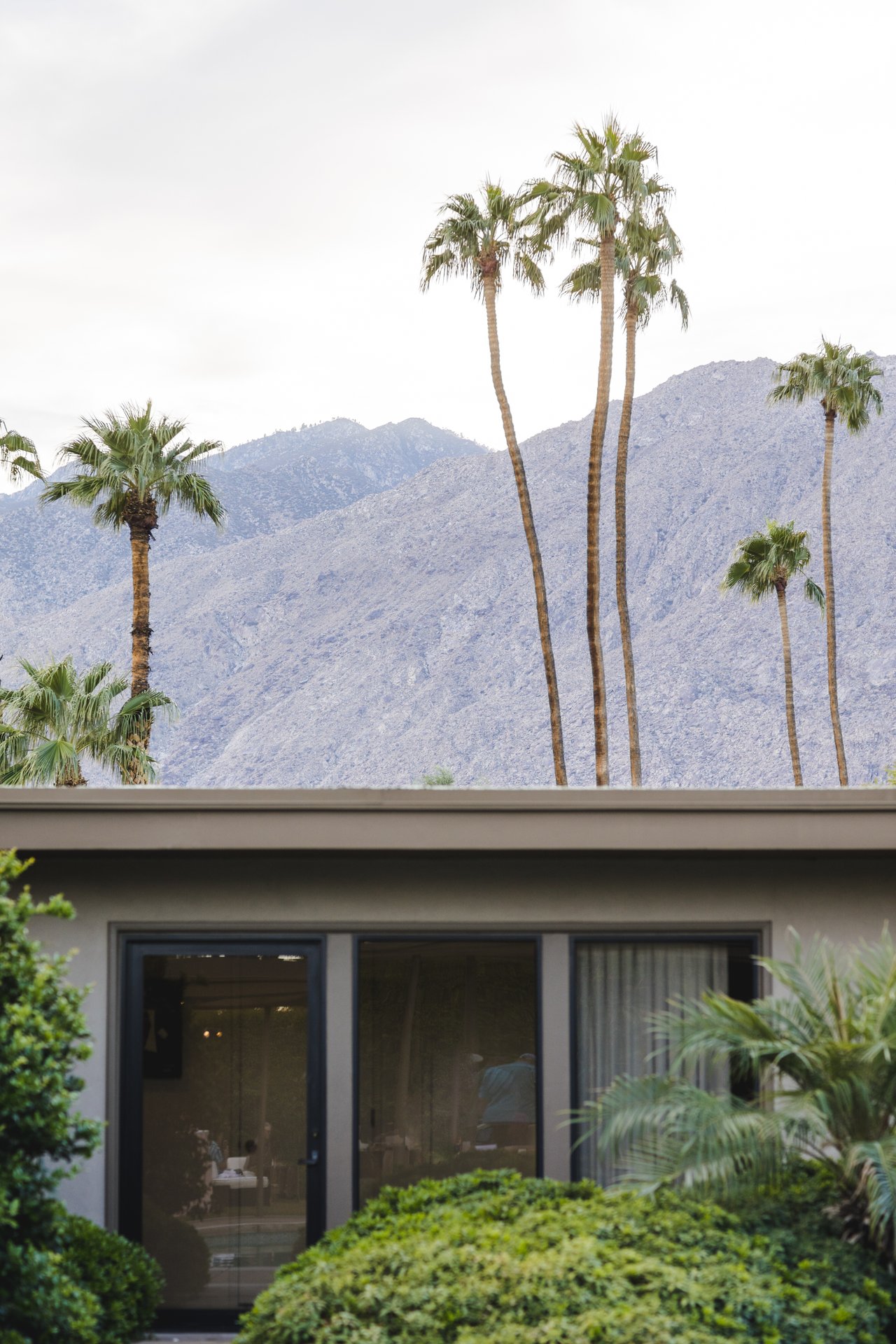
His philosophy was direct: architecture should belong to its place. In the Coachella Valley, that meant low horizontal lines that echo the mountain ranges, deep overhangs that manage the brutal afternoon sun, floor-to-ceiling glass that dissolves the boundary between inside and outside, and materials that work with the climate rather than fight it.
What Williams created at Twin Palms — and refined over five decades — is the template for what the market now calls desert modernism. This is not simply mid-century modern transposed to a warm climate. It is a specific response to this specific geography: the low winter sun, the Santa Rosa Mountains to the south, the San Jacintos to the west, and a sky so clear it almost seems curated.
I have walked through homes designed by Williams, Albert Frey, William Krisel, and Donald Wexler many times over thirty years. Every one of them has something in common: they feel right in the desert in a way that imported or replicated styles simply do not. The proportions, the overhangs, the relationship to the ground — it reads as deeply considered. Because it is.
What Architecture Pedigree Means When You’re Buying
The most consistent question I hear from serious buyers — the ones who ultimately make offers — is some version of: who designed this?
It matters more than most buyers initially realize. A home with a documented attribution to Williams, Frey, Krisel, or Wexler is not simply an older house with a good story. It is an asset with a built-in audience: national and international buyers who search specifically for architect-attributed properties in Palm Springs and will pay a meaningful premium for them.
In Movie Colony East, where Twin Palms sits, homes currently range from approximately $925,000 to $1.9 million with no HOA. The neighborhood has over 700 homes, many built from the late 1930s through the 1960s, in a mix of Spanish Colonial and mid-century modern styles. Homes with documented architectural attribution and sensitive restoration consistently sit at the upper end of that range — and tend to spend fewer days on market. (Source: Zillow/Redfin, May 2026.)
[Norman: Insert a specific example — a listing in Movie Colony East, Old Las Palmas, or Vista Las Palmas where the architect attribution was a meaningful factor in the buyer’s decision or the final price.]
The pattern holds across the valley. In Deepwell, in Indian Canyons, in the historic core of Palm Springs — wherever the architecture has a name attached and has been handled with care, the premium is real and compounds over time. These are not just homes. They are primary sources.
How to Experience It This June
Modernism Week’s participation in XOXO Palm Springs (June 11–22, 2026) offers one of the few public access opportunities to walk through Twin Palms: a self-guided tour through the private residence and grounds, including the historic pool area. Described as a one-time-only summer offering, this kind of access rarely becomes available to the public.
The broader XOXO event also features mini-coach architecture tours of Palm Springs’ modernist neighborhoods, led by Modernism Week’s professional guides. These are the same tours offered during the February flagship festival, now extended into summer for the first time. Tickets and full programming are available at modernismweek.com.
If you have been wanting to understand — really understand — why Palm Springs’ architectural heritage commands the prices it does, walking this house is among the most direct ways to do it. Stand at the piano pool. Look at the relationship between the roofline and the mountains. The premium you have seen in listing data will make immediate sense.
FAQ: E. Stewart Williams, Twin Palms, and Desert Modernism
Who designed Frank Sinatra’s house in Palm Springs?
E. Stewart Williams designed Twin Palms in 1947. It was his first residential commission and one of the defining buildings of the desert modern movement in the Coachella Valley.
What is desert modernism?
Desert modernism is a regional variant of mid-century modern architecture developed specifically for the Coachella Valley. It emphasizes horizontal lines, deep overhangs, floor-to-ceiling glass, and indoor-outdoor integration adapted for the desert climate. Key architects include E. Stewart Williams, Albert Frey, William Krisel, Donald Wexler, and William Cody.
Does architectural attribution affect home value in Palm Springs?
Yes, meaningfully. Homes with documented attributions to prominent mid-century architects consistently command price premiums and attract buyers from a national and international pool. Sensitive restoration — preserving original details rather than renovating past recognition — adds further value.
Can I visit Frank Sinatra’s Twin Palms estate?
The estate is a private residence but opens for tours through Modernism Week events. The summer 2026 opportunity runs June 11–22 as part of XOXO Palm Springs. Tickets and information are available at modernismweek.com.
What neighborhood is the Twin Palms estate in?
Twin Palms is in Palm Springs’ Movie Colony East neighborhood, formerly known as the Ruth Hardy Park area. The neighborhood has no HOA, over 700 homes, and current pricing from approximately $925,000 to $1.9 million. (Source: Zillow/Redfin, May 2026.)
How does E. Stewart Williams compare to other mid-century Palm Springs architects?
Williams is considered one of the defining figures of desert modernism in Palm Springs alongside Albert Frey, Donald Wexler, and William Krisel. While Frey emphasized extreme integration with the desert landscape and Wexler pioneered prefab steel construction, Williams worked across civic and residential projects that balanced modernist principles with client livability. His range — from private residences to the city’s primary art museum — gives him an unusually wide footprint across Palm Springs.
All real estate market figures referenced from Zillow and Redfin data, May 2026. Architectural history sourced from the Palm Springs Preservation Foundation and Modernism Week archives. HOA status, prices, and market conditions are subject to change — verify directly with your agent before making purchasing decisions.
Love the idea of owning a home with real architectural bones? I curate a personalized email of current mid-century modern listings in Palm Springs and the greater Coachella Valley — homes with provenance, design integrity, and lasting value. Reach me directly at [email protected] to get on the list.
Written by Norman Williams, Coachella Valley real estate professional with 30 years in the market. Norman specializes in mid-century modern and desert contemporary architecture, golf communities, and luxury residential sales in La Quinta, Indian Wells, Rancho Mirage, Palm Desert, and Palm Springs.